

Why Crypto Exchange Rates Differ - ExSora
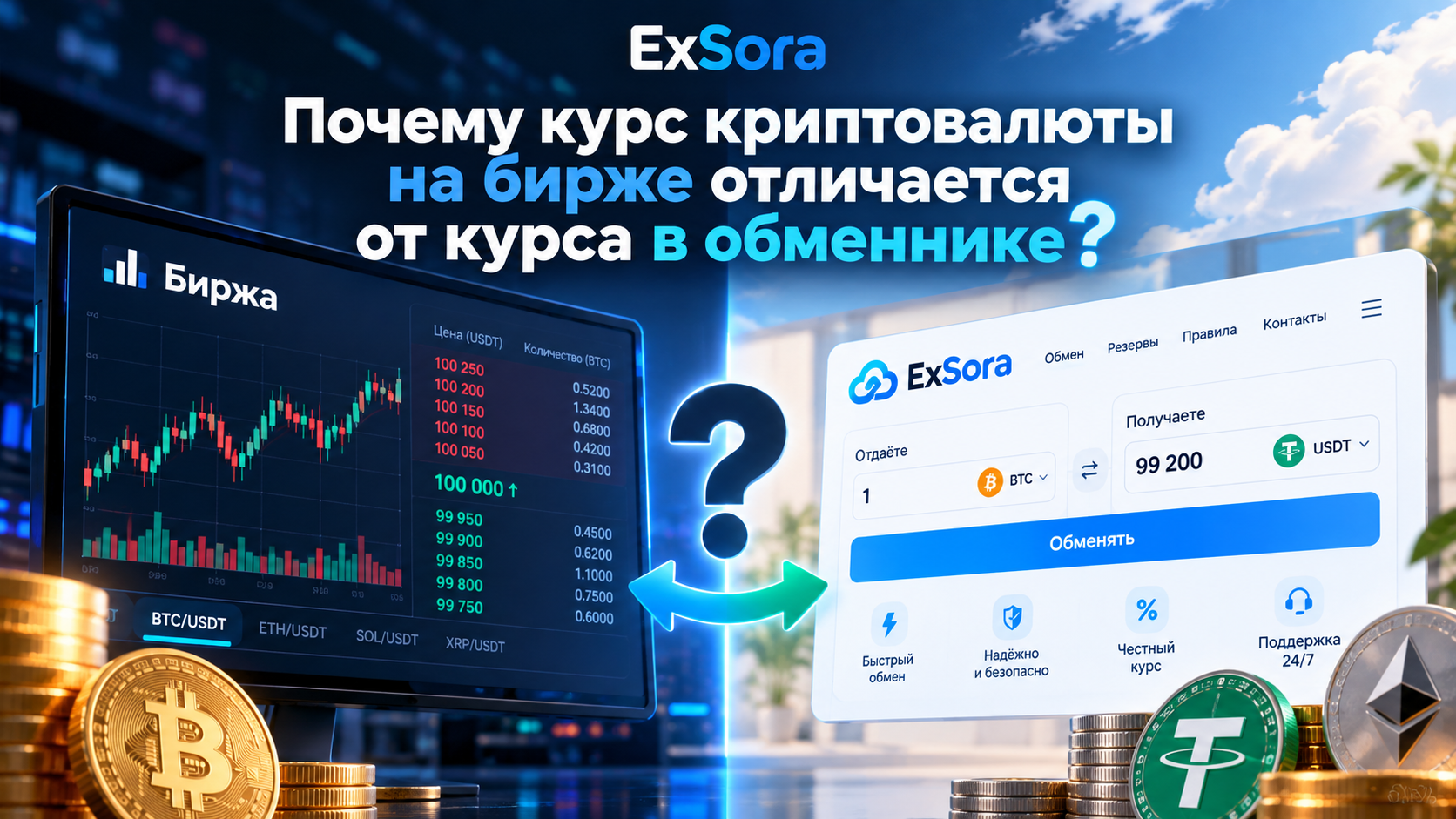
Why Are Cryptocurrency Exchange Rates Different on Trading Platforms and Exchange Services?
When exchanging cryptocurrency, users often notice that the same digital asset may have different prices across platforms.
For example, Bitcoin might trade at 100,000 USDT on a cryptocurrency exchange, while an exchange service offers a different buying or selling rate. Similar differences can occur when converting USDT into Russian rubles, euros, or other currencies.
This raises an important question: why do cryptocurrency exchange services offer rates that differ from market quotations, and does a different rate necessarily mean a worse deal?
In reality, these differences may result from liquidity, fees, operating costs, market risks, and the payment methods involved.
In this article, the ExSora team explains how exchange rates are determined, what spreads are, and why users should consider more than just the displayed asset price.
1. How Are Prices Determined on Cryptocurrency Exchanges?
A cryptocurrency exchange is a trading platform where participants buy and sell digital assets.
Prices are determined through the interaction of buyers and sellers.
When demand for an asset increases, its price may rise. When selling pressure exceeds demand, its price may fall.
For example, one trader may be willing to buy Bitcoin for 100,000 USDT, while another offers to sell it for 100,050 USDT.
The difference between the best available buying and selling prices is known as the bid-ask spread.
Exchange interfaces often display the last traded price or another market reference price. However, this does not mean that every user can immediately buy or sell any amount at exactly that price.
The actual execution price depends on order book liquidity, trading volume, and available offers.
Even within a single cryptocurrency exchange, buying and selling prices can therefore differ.
2. How Do Cryptocurrency Exchange Services Set Their Rates?
Unlike trading exchanges, where users place their own buy and sell orders, cryptocurrency exchange services provide ready-made exchange directions.
Examples include:
USDT to RUB — exchanging Tether for Russian rubles.
BTC to USDT — converting Bitcoin into Tether.
XMR to USDT — converting Monero into Tether.
USDT to EUR — exchanging Tether for euros.
USDT to an electronic payment system — receiving funds through a selected payment method.
An exchange service calculates its offered rate based on market prices and the conditions of each transaction.
Several factors may influence the final rate.
Market quotations. Exchange services may use prices from cryptocurrency exchanges and other liquidity providers.
Available reserves. The service must hold or obtain sufficient assets to complete the transaction.
Transaction fees. Cryptocurrency transfers, payment processing, and bank payouts may involve additional expenses.
Market risk. Digital asset prices may change between the creation and completion of an exchange request.
Payment direction. Sending funds to a bank card, electronic wallet, or cryptocurrency address involves different processing requirements.
Operating costs. Payment infrastructure, customer support, security procedures, and transaction processing require resources.
As a result, an exchange service may offer rates that differ from those displayed on a trading platform, even when both follow the same underlying market.
3. What Is a Spread and Why Does It Exist?
A spread is the difference between an asset's buying and selling prices.
Spreads exist on both cryptocurrency exchanges and exchange services.
Consider a simplified example.
Suppose the reference market value of one USDT is 90 RUB.
An exchange service offers:
Buying USDT from a customer: 89 RUB.
Selling USDT to a customer: 91 RUB.
The difference is 2 RUB.
However, the spread is not the same as an exchange service's net profit.
It may help cover payment processing charges, liquidity costs, transaction expenses, operational risks, and other costs.
Therefore, a larger spread does not automatically mean greater profitability, just as a smaller spread does not guarantee the absence of additional charges.
For users, the most important figure is the final amount they will receive after completing the exchange.
4. Why Can the USDT-to-RUB Rate Differ From the Dollar Exchange Rate?
USDT is a stablecoin designed to track the value of the US dollar.
However, the price of USDT in Russian rubles does not always match the official USD/RUB exchange rate or the quotation displayed on a particular cryptocurrency platform.
There are several reasons.
Differences Between Markets
The price of USDT in rubles depends on supply and demand across available trading and settlement venues.
A bank's dollar exchange rate and the market price of USDT are not necessarily identical.
Banking and Payment Conditions
Payouts to bank cards or through the Faster Payments System may involve different operational requirements and costs.
Payment availability and settlement conditions can also influence exchange rates.
Available Liquidity
If buying or selling a particular amount of USDT is difficult, the cost of obtaining sufficient liquidity may increase.
Market Fluctuations
Cryptocurrency quotations can change throughout the day. A rate available in the morning may not remain available in the evening.
Conclusion: when exchanging USDT for rubles, users should compare offers with the same payout method rather than relying exclusively on an official foreign exchange rate.
5. How Does Transaction Size Affect the Exchange Rate?
The size of an exchange request can influence its execution conditions.
Suppose a user wants to exchange 100 USDT. Processing such an amount may be relatively straightforward if sufficient liquidity is available.
However, a significantly larger exchange might require additional reserves or multiple transactions to obtain the necessary funds.
On a trading exchange, large orders may cause slippage, meaning that parts of the order are executed at different price levels.
An exchange service may take similar liquidity considerations into account when preparing an offer or negotiating an individual rate.
However, larger transactions are not always less favorable. Some services may provide special terms for certain amounts.
For substantial exchanges, it is useful to confirm the available reserves and final calculation conditions in advance.
6. Why Do Different Exchange Services Offer Different Rates?
Even for the same exchange direction, such as USDT to RUB, several services may display different quotations at the same time.
This happens because each provider uses its own infrastructure, reserves, and liquidity sources.
One service may have a larger reserve of Russian rubles. Another may obtain cryptocurrency under more favorable conditions. A third may face additional expenses associated with the selected payout method.
Market conditions, available funds, and risk management policies also influence the offered rate.
However, the highest displayed rate does not always represent the best overall exchange offer.
Before creating an exchange request, users should check:
The final payout amount.
Minimum and maximum exchange limits.
Available currency reserves.
Possible additional fees.
Exchange rate fixation conditions.
Payment processing requirements.
The service's reputation and customer support.
An exchange service should therefore be evaluated based on the overall transaction conditions rather than a single number.
7. What Matters More: A Better Rate or a Reliable Exchange?
Suppose two exchange services offer to convert 1,000 USDT into Russian rubles.
The first offers 89.50 RUB per USDT, while the second offers 90 RUB.
The difference in the payout is:
1,000 × 0.50 = 500 RUB.
At first glance, the second offer appears more attractive.
However, users should also verify that:
Sufficient reserves are available.
Payout conditions are clearly explained.
There are no unexpected additional fees.
AML/KYC policies are accessible.
The timing of exchange rate fixation is clear.
Customer support is available if problems arise.
A competitive exchange rate matters, but transparent conditions and transaction security are equally important.
This is especially relevant when exchanging larger amounts.
8. Why Might the Final Payout Differ From the Initial Estimate?
Sometimes the final payout differs from the amount initially displayed when an exchange request was created.
This does not necessarily mean that the exchange service increased its fees.
One possible explanation is the exchange rate fixation mechanism.
With a fixed rate, the payout remains unchanged as long as the stated conditions are met.
With a floating rate, the final calculation takes place at a specified processing stage, meaning that market price changes may affect the payout.
Blockchain confirmation times, the amount actually received, and applicable fees may also influence the result.
That is why users should carefully review the conditions for their selected exchange direction before transferring funds.
9. How Does ExSora Determine Its Exchange Rates?
At ExSora, exchange rates depend on the selected direction, current market conditions, and transaction processing requirements.
Users can review the offered rate and estimated payout before creating an exchange request.
For certain directions, the exchange rate is automatically locked when the request is created and remains valid if the stated conditions are satisfied.
For other directions, particularly those involving longer blockchain confirmation times, the final calculation may take place at a later stage.
If the asset's market value changes during this period, the final payout may be adjusted upward or downward.
Exchange requests are processed in accordance with the service's terms, required blockchain confirmations, and applicable security procedures.
If users have questions about the exchange rate or final payout, we recommend contacting ExSora support before sending funds.
10. How Should You Compare Cryptocurrency Exchange Rates?
To select a suitable exchange offer, consider the following recommendations.
1. Compare identical exchange directions. A USDT-to-RUB bank card payout should not automatically be compared with a different payout method.
2. Check the final payout amount. The amount actually received provides a clearer picture than the quoted rate alone.
3. Consider fees. Blockchain transaction fees, bank charges, and payment provider costs may affect the result.
4. Verify available reserves. Make sure the exchange service can process the required amount.
5. Understand when the rate is locked. This is particularly important for cryptocurrencies with longer confirmation times.
6. Review the terms and feedback. Pay attention to customer experiences and how disputes are handled.
7. Ask questions before transferring funds. Contact support if any conditions are unclear.
Conclusion
Differences between cryptocurrency trading prices and exchange service rates are common and can result from market, technical, and operational factors.
Trading exchanges determine prices through orders placed by market participants. Exchange services offer ready-made exchange rates that account for liquidity, operating expenses, available reserves, and payment processing conditions.
When choosing an exchange service, users should consider not only the quoted rate but also the final payout, transparency of terms, and reliability of the transaction process.
The ExSora team recommends reviewing all exchange request details and understanding the applicable conditions before proceeding.
ExSora — Cryptocurrency and Electronic Currency Exchange.
Official website: https://exsora.cc